




Choosing the Right Full-Arch Implant Restoration
A patient walks in with a failing upper denture, four implants already placed, and moderate ridge resorption across the arch. They want something fixed. Something permanent. The anatomy tells you a traditional crown and bridge emergence profile isn’t going to work here, because there’s too much vertical bone loss for that. So now the question becomes: what material, what design, and how do you make sure this case holds up five years from now?
This is where the conversation about the hybrid prosthesis begins. And if you’ve been doing full-arch work for any length of time, you know the material decision is where things get interesting, and where a lot of cases succeed or run into trouble down the road.
At Burbank Dental Lab, we fabricate hundreds of full-arch restorations every year. We see what works, what comes back, and what clinicians wish they’d done differently. This article breaks down the four primary prosthetic categories for edentulous patients, explains where hybrid prostheses fit within that spectrum, and delves into the material question, including why we developed SmartComposite to address problems we kept seeing with other approaches.

REQUEST THE BURBANK DENTAL LAB FEE SCHEDULE
REQUEST FEE SCHEDULE
Understanding the Full-Arch Prosthetic Spectrum
Before we talk about hybrids specifically, it helps to step back and look at the full range of implant-supported options. Not every edentulous patient is a hybrid case, and choosing the wrong category creates problems that no material can fix.
Implant-Retained Overdentures use attachments like Locator or ERA systems to improve retention over a conventional denture. The prosthesis is still tissue-supported, the implants just keep it from moving around. This works well for patients who want improved stability but aren’t candidates for (or aren’t interested in) a fixed restoration. It’s also the most cost-accessible option.
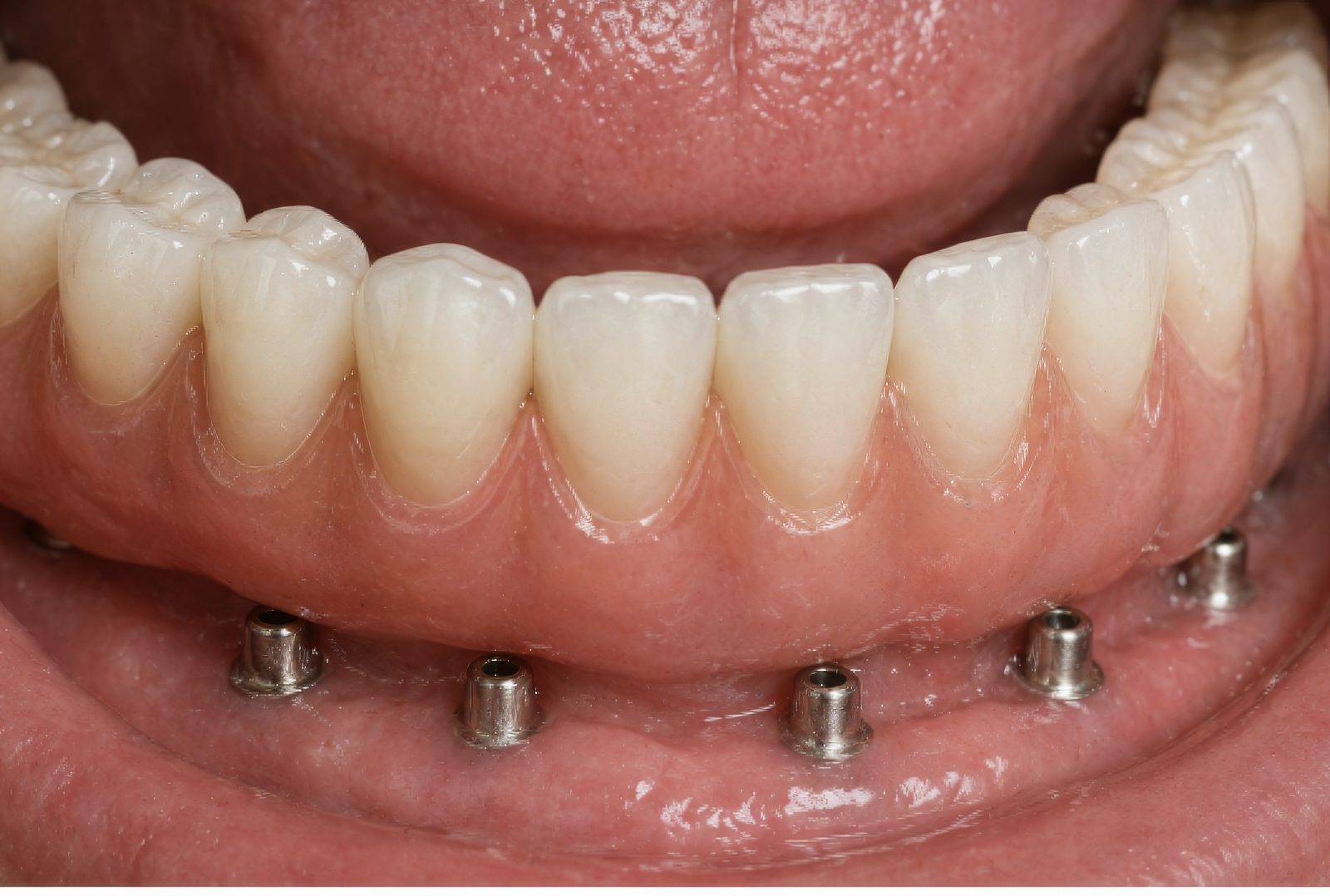
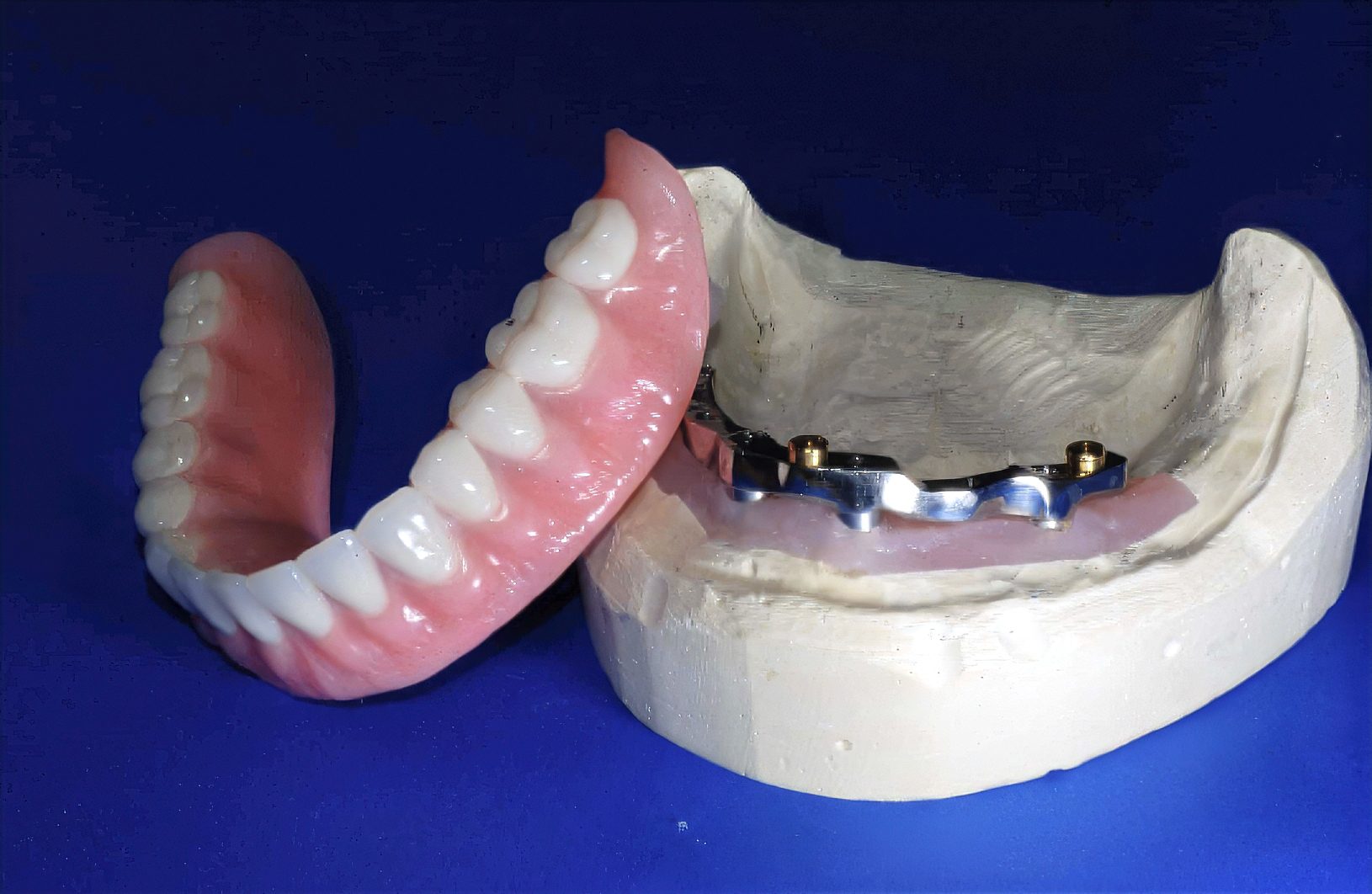
Bar-Supported Overdentures take retention a step further by splinting implants together with a custom milled bar — a Hader bar or locator bar system. The bar distributes load more evenly and provides significantly better stability than individual attachments. The prosthesis is still removable by the patient, but it feels more secure.
FREE TO DOWNLOAD – SUCCESS GUIDES
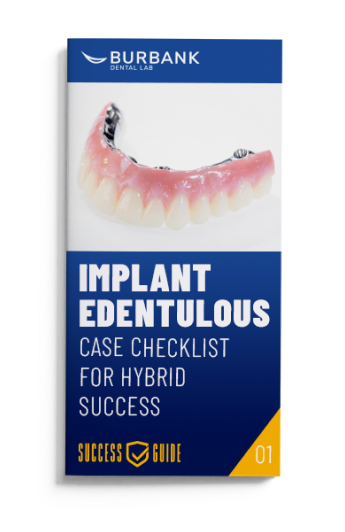
DOWNLOAD A GUIDE
An added benefit and planning consideration: when bone resorption has left the patient with little or no lip support, the denture flange can be extended to restore full lip support, something a fixed hybrid prosthesis, which has no labial flange, cannot provide.
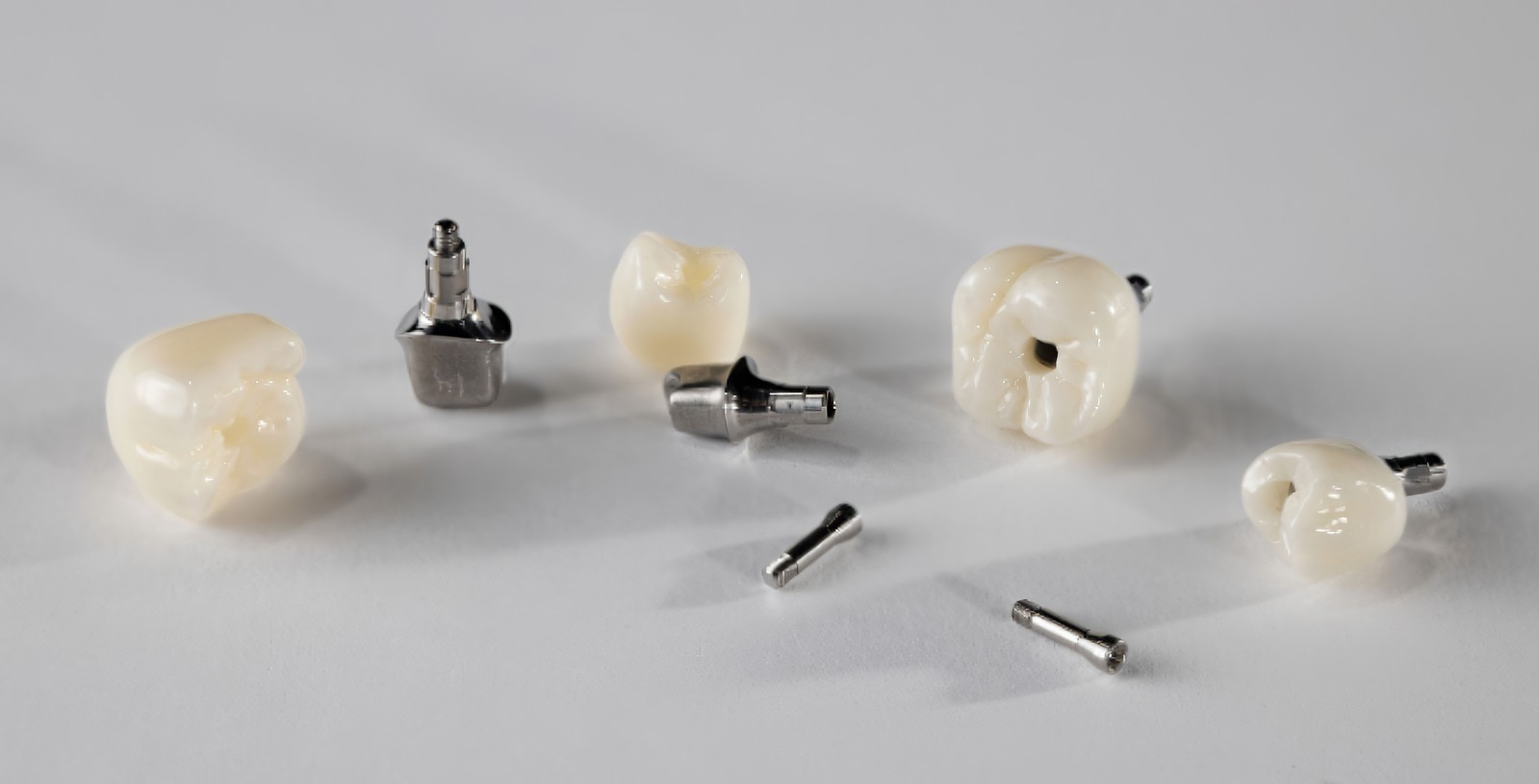
Implant-Supported Crown and Bridge restorations mimic the natural emergence of teeth from the tissue. These are beautiful when the anatomy supports them. In Carl Misch’s prosthetic classification, these are an FP-1 (Fixed Prosthesis 1) design, they replace the clinical crown only and depend on near-natural emergence from intact, preserved tissue. The criteria are minimal bone loss, preserved papillae, and sufficient soft-tissue architecture to create natural emergence profiles. The problem is that this scenario is relatively uncommon in the fully edentulous patient. When significant resorption has occurred, forcing a crown and bridge design leads to overly long clinical crowns, black triangles, and compromised esthetics.
Rather than trying to emerge from tissue that isn’t there, a hybrid restoration acknowledges the anatomical reality and builds the gingival component into the prosthesis itself.
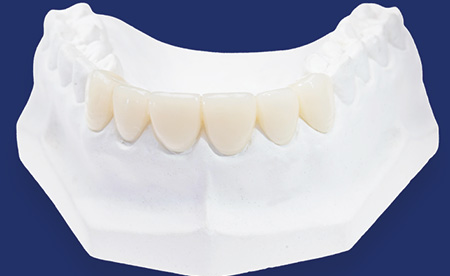
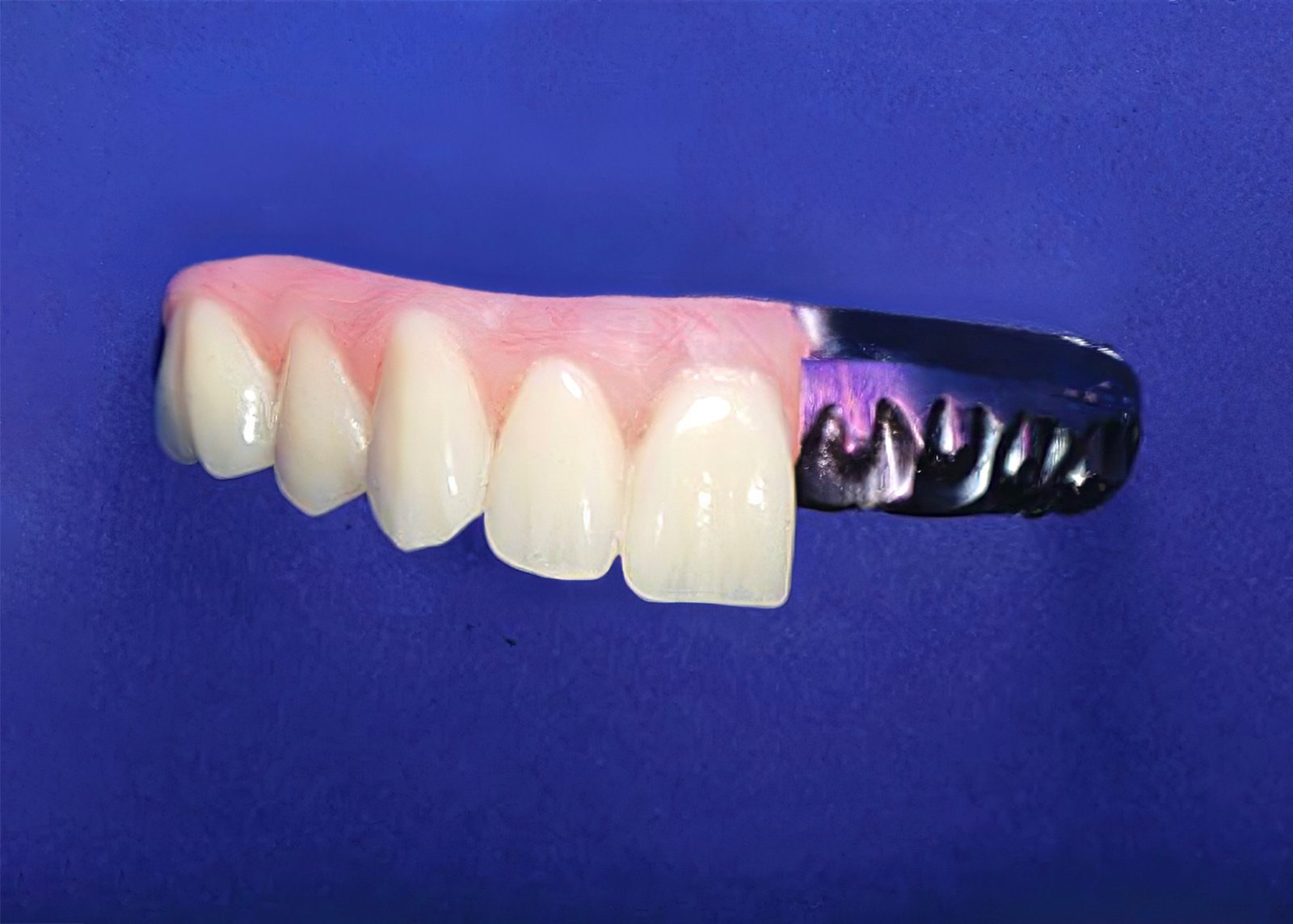
Hybrid Prostheses represent a fundamentally different design approach. These are fixed, screw-retained restorations that replace both teeth and missing soft tissue. That’s the key distinction. In Carl Misch’s classification, hybrid prostheses fall into the FP-2 and FP-3 categories. An FP-2 is a minimal-tissue prosthesis with moderately elongated clinical crowns, used when resorption is moderate and the lip line conceals the cervical transition. An FP-3 is a tissue-replacing prosthesis that incorporates a gingival (pink) component, used when the transition line between the prosthesis and natural tissue falls below the patient’s smile line. Rather than trying to emerge from tissue that isn’t there, a hybrid restoration acknowledges the anatomical reality and builds the gingival component into the prosthesis itself.
If your patient has moderate to severe ridge resorption, which is the case in the majority of fully edentulous patients, the hybrid prosthesis is likely where you’ll land.
When Is A Hybrid the Right Call?
Hybrid prostheses aren’t just for cases where other options don’t work. They’re often the best option when:
The clinical question isn’t really whether a hybrid is appropriate for your edentulous patient with resorption. It’s which hybrid material gives you the best long-term outcome for that specific case.
The Material Decision: Where Cases Succeed or Struggle
The material choice has real downstream consequences. Here’s what we see in the lab and what we hear back from doctors over time.
This is where we spend a lot of time in consultation with clinicians, because the material choice has real downstream consequences. Here’s what we see in the lab and what we hear back from doctors over time.
Acrylic with Metal Substructure (Titanium or CoCr)
This is the original hybrid design, a metal framework with acrylic and individual denture teeth processed onto it. It has the longest clinical track record and remains a solid, cost-effective option.
The upside: it’s lightweight, it’s kind to opposing dentition, and when a tooth pops off (which happens), repair is straightforward. The lab can turn around a denture tooth replacement quickly.
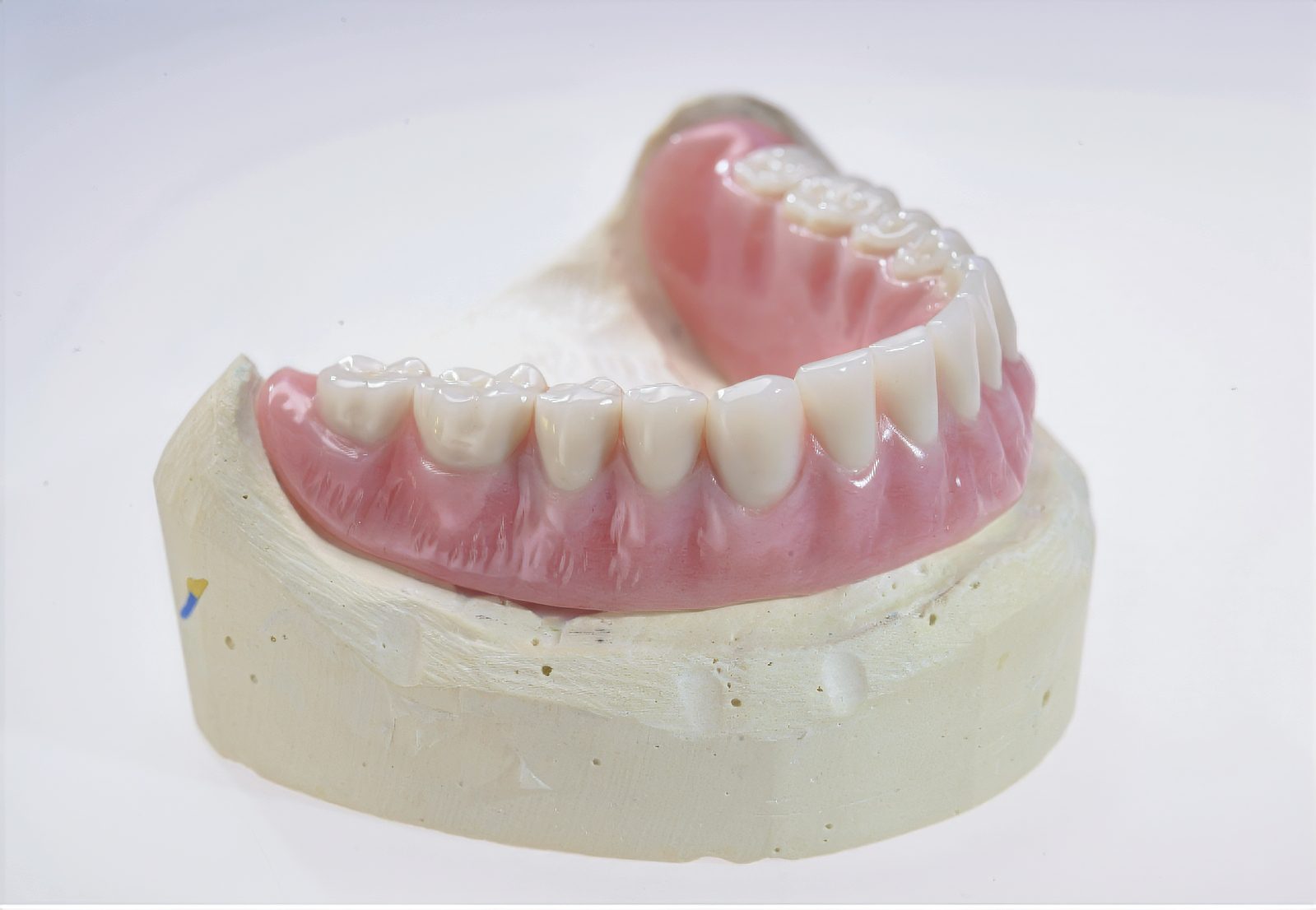
The downside: acrylic is porous. Over time, it absorbs fluids and odors. Staining becomes noticeable. Individual denture teeth can debond from the acrylic base; this is the most common maintenance issue we see with traditional hybrids. And the material wears faster than natural enamel, so occlusal contacts shift over time.
Monolithic Zirconia
Zirconia hybrids have gained enormous popularity, and for good reason. The material is incredibly strong (flexural strength above 1,000 MPa), doesn’t stain or absorb, and looks outstanding. For patients who want something that feels closest to natural teeth in terms of durability and esthetics, zirconia is hard to beat.
The upside: it’s lightweight, it’s kind to opposing dentition, and when a tooth pops off (which happens), repair is straightforward. The lab can turn around a denture tooth replacement quickly.
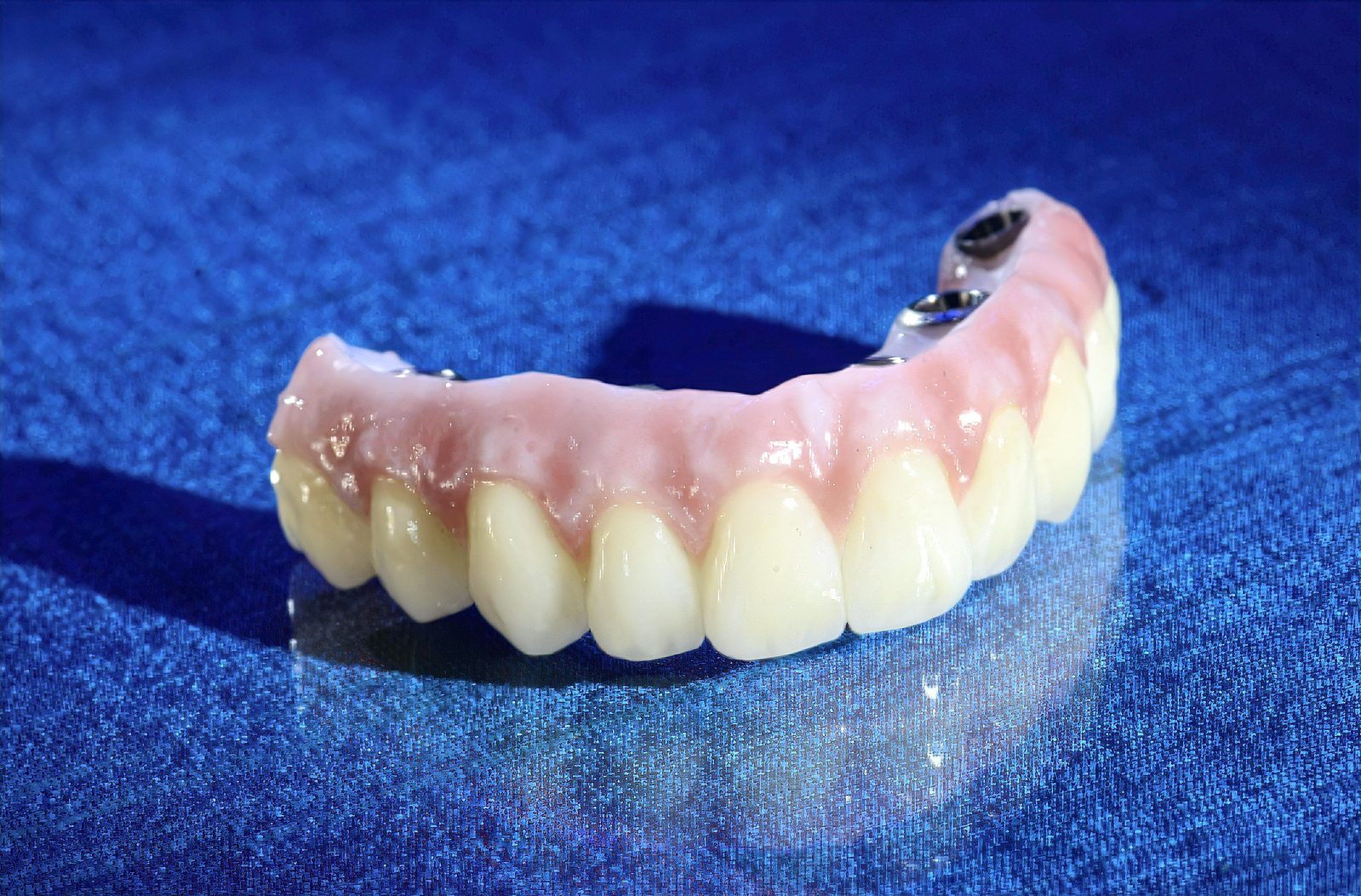
But zirconia’s rigidity is a double-edged sword. It transmits occlusal forces directly to the implants and underlying bone with very little shock absorption. In cases with parafunction, and let’s be honest, a significant percentage of full-arch patients clench or grind, that force transmission can become a problem over time. We also see this when monolithic zirconia is placed in both arches: two rigid structures occluding against each other with no give.
The other consideration is repairability. If a zirconia prosthesis chips or fractures, you’re not fixing that chairside. The restoration is sent out and returned to the dental lab. That means a period without the prosthesis for the patient, and a more costly repair process.
Porcelain Fused to Metal 9PFM) or Porcelain Fused to Zirconia
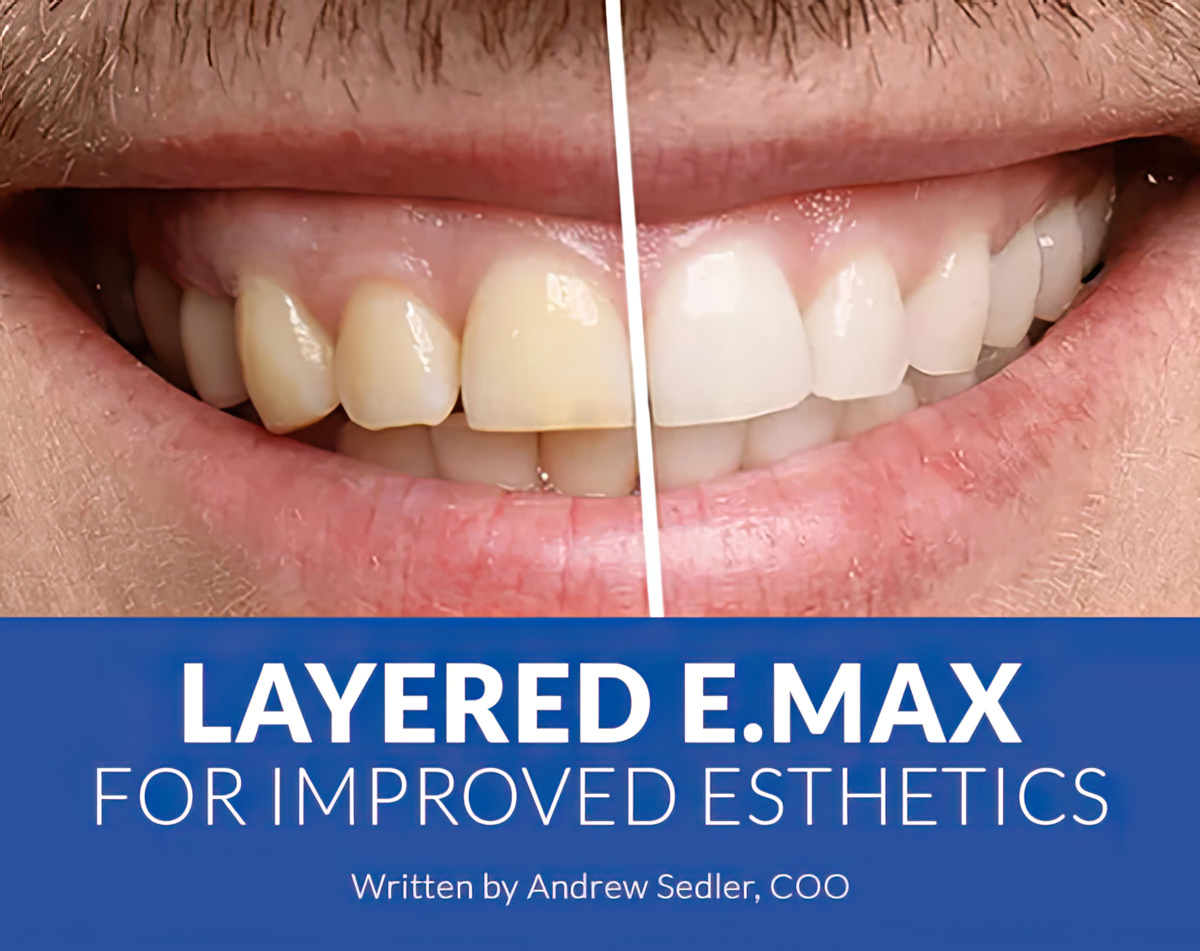
These options offer excellent esthetics, layered porcelain provides translucency and depth of color that monolithic materials can’t fully replicate. But the layered porcelain is the weak link. Chipping and delamination are well-documented concerns, and when they occur, the entire prosthesis typically needs to come out for repair. For a full-arch restoration, that’s a significant disruption.
Milled Composite on a Metal Framework – SmartComposite
This is where we saw an opportunity to solve a set of recurring problems across the other material categories. Clinicians were telling us they wanted something stronger and more stable than acrylic, more forgiving than zirconia, and repairable without pulling the case. That feedback is what led us to develop SmartComposite.
SmartComposite: What It Is and Why We Built It
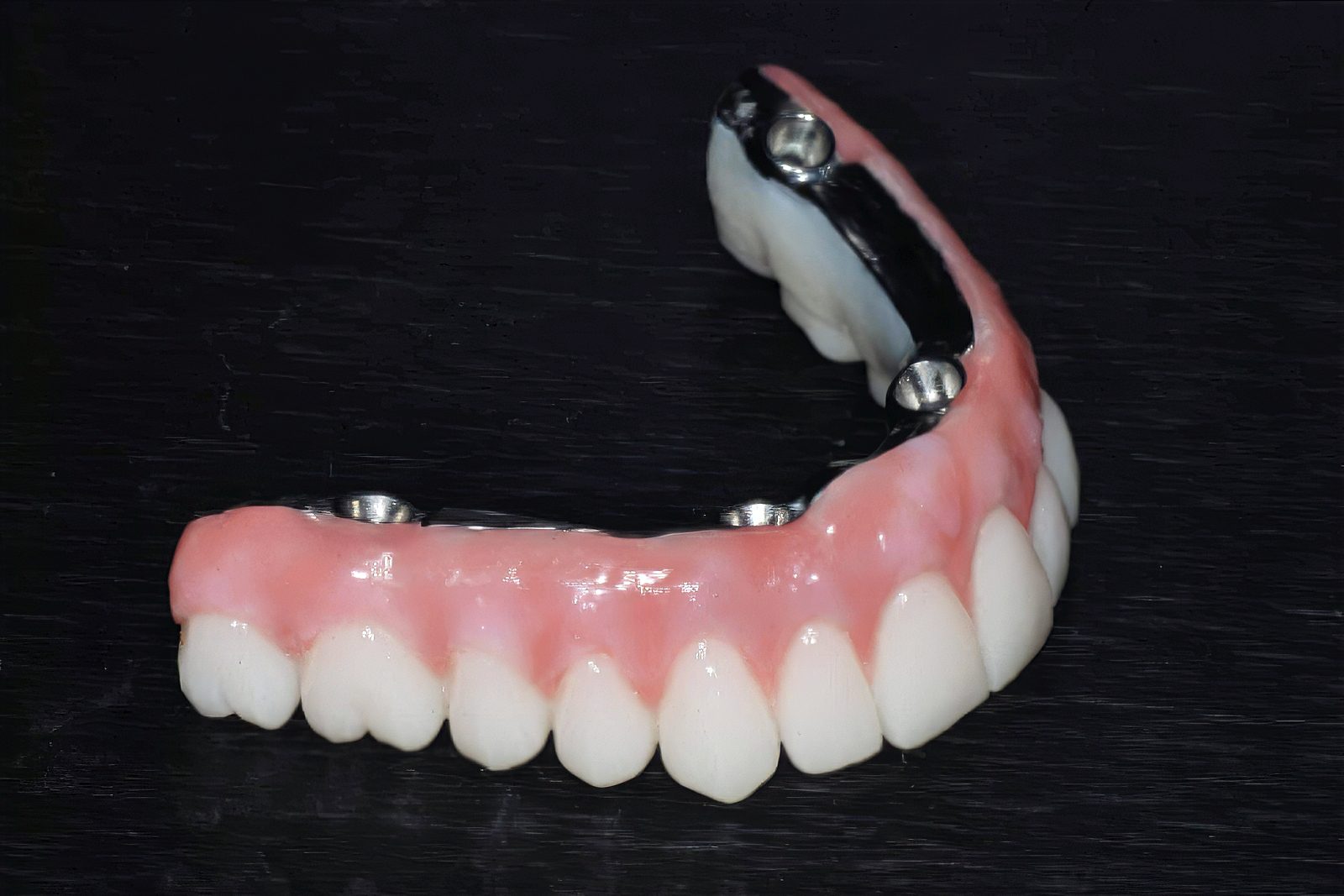
SmartComposite is a milled hybrid prosthesis that combines a cobalt-chromium substructure with a monolithic composite overlay. It’s not acrylic with teeth stuck on. It’s not zirconia. It’s engineered to sit in the middle ground, rigid enough to be durable, resilient enough to absorb functional stress, and practical enough to repair in the mouth when something needs attention.
Clinicians were telling us they wanted something stronger and more stable than acrylic, more forgiving than zirconia, and repairable without pulling the case.
How We Fabricate SmartComposite
Every SmartComposite case starts the same way: with a validated denture setup. Before we mill anything, the esthetics, phonetics, vertical dimension, and occlusal scheme are approved by the clinician and the patient. We’ve seen what happens when this step gets rushed or skipped, and it’s never worth the time saved.
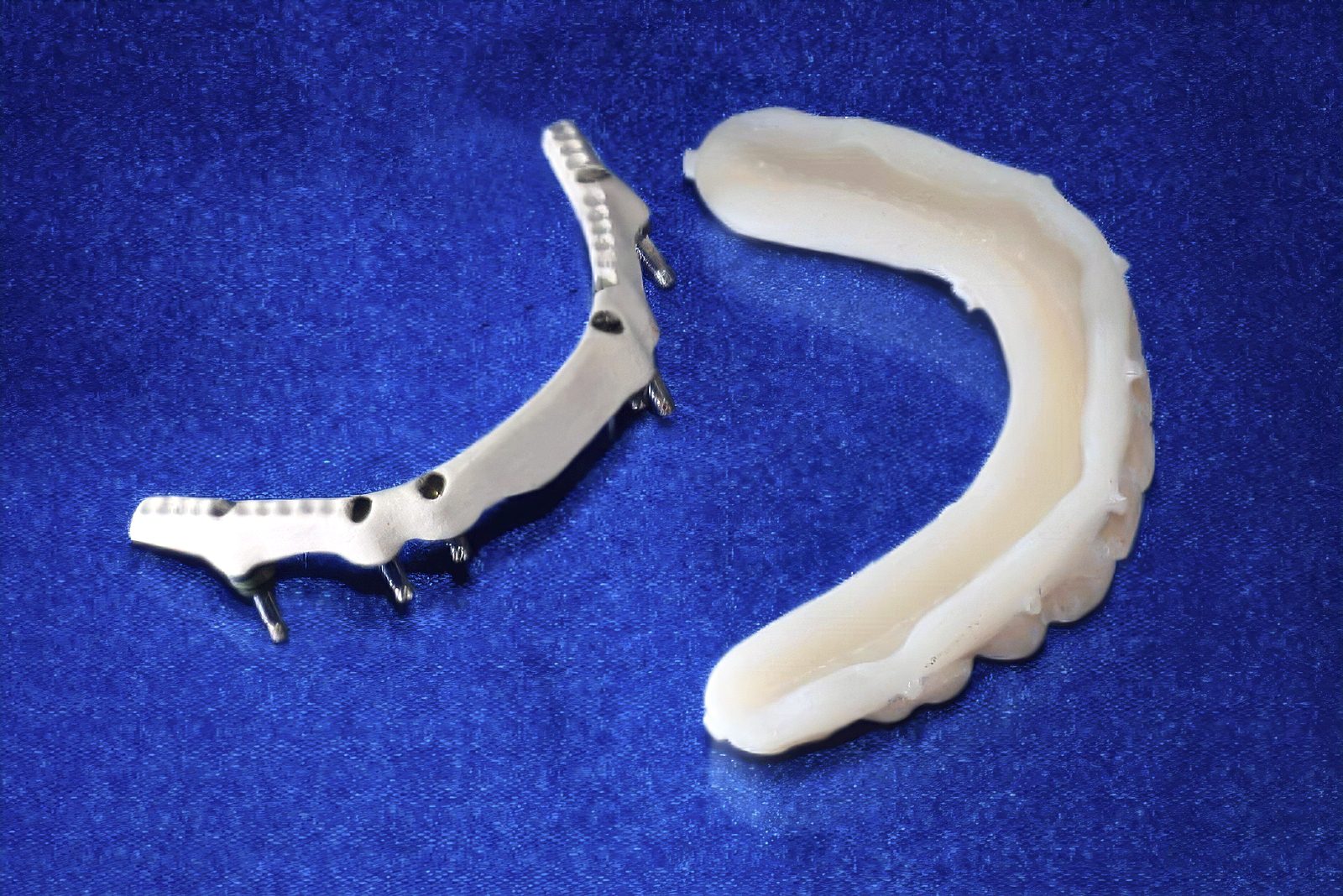
From the approved setup, we mill a cobalt-chromium substructure. This provides the restoration’s rigid backbone. Then we mill a monolithic composite overlay as a single piece. The metal framework gets opaqued and etched for mechanical and chemical bonding. The composite is bonded to the framework, and our technicians complete the gingival characterization and hand-polishing to match the patient’s tissue.
The key word here is milled. Because the composite is milled from a single block rather than hand-packed or layered, it’s fully polymerized, dense, and free of the voids and weak points that plague traditionally processed acrylic.
What This Means Clinically
Strength with controlled flexibility. The CoCr framework handles structural loads. The composite introduces just enough resilience to modulate the forces reaching the implants. This is particularly valuable when the opposing arch is restored with zirconia, a common scenario in which placing zirconia against zirconia creates a system with no shock absorption at all. Many clinicians are choosing zirconia in one arch and SmartComposite in the opposing arch to achieve biomechanical balance.
No tooth dislodgement. Because this is a monolithic composite, one continuous piece, there are no individual teeth to debond. This eliminates the single most common repair issue with traditional acrylic hybrids.
Chairside repairability. If the composite needs adjustment, contouring, or repair, it can be done intraorally. No need to remove the prosthesis, send it to the lab, and leave the patient without their teeth. For patients and clinicians, this is one of the most practical advantages.
Wear compatibility. The composite wears at a rate similar to natural enamel. It won’t abrade opposing natural teeth the way harder materials can, and it maintains occlusal stability over time.
Resistance to absorption. Unlike acrylic, the dense milled composite resists fluid and odor absorption. Patients notice this; they report better long-term hygiene and fewer issues with taste or smell.
Reduced weight. Compared to zirconia, SmartComposite is noticeably lighter. In a full-arch prosthesis, this directly translates into patient comfort, especially in the maxilla.
Space Requirements: The Numbers That Matter
Regardless of which material you choose, a hybrid prosthesis needs adequate restorative space to function. Insufficient space leads to thin, fracture-prone restorations and compromised esthetics.
These aren’t suggestions — they’re structural minimums.
For SmartComposite specifically, the minimum requirements are:
These aren’t suggestions, they’re structural minimums. If your case doesn’t meet these parameters, we need to discuss it before moving forward. This is exactly the kind of thing that benefits from early lab involvement in the treatment planning process.
Choosing Between Materials: A Clinical Framework
There’s no universal answer to “which material is best.” The right choice depends on the case at hand.
Here’s how we think about it:
In practice, a growing number of dental clinicians are using a split-arch approach: zirconia in one arch and SmartComposite in the other. This gives them the esthetics and durability of zirconia where it matters most, with the shock absorption and repairability of composite where it provides the most biomechanical benefit.
The most predictable full-arch outcomes we see share one thing in common: the clinician and the lab were communicating before the implants went in.
Get The Dental Lab Involved Early
The most predictable full-arch outcomes we see share one thing in common: the clinician and the lab were communicating before the implants went in. Implant position, angulation, restorative space, and material selection are all interconnected.
When we’re involved early, we can flag potential issues, insufficient interocclusal space, implant positions that complicate framework design, opposing arch considerations, before they become problems that limit your prosthetic options.
If you’re planning a full-arch case and want to discuss material options, workflow, or whether SmartComposite is the right fit, call our technical support team or contact us here. We’re here to help you plan the case, not just fabricate the restoration.
FAQ


 Previous Post: